

European-established neurological training system seeking one exclusive U.S. institutional training partner.
Executive Overview
Developed in Germany in 2013, this structured, music-integrated neurological training system has been implemented in approximately 20 countries and applied by more than 400 healthcare professionals.
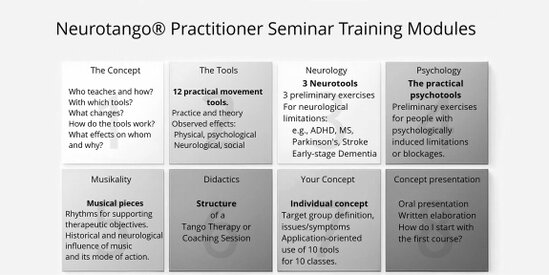
The professional qualification is organized into eight modules covering clinical practice, didactics, program design, neurology, psychology, and structured musical integration.
The curriculum includes three defined tool categories:
- the Neurotango Tool Set,
- the Neuro Tools, and
- the Psycho Tools.
The twelve practical Neurotango Tools are directly structured around nine defined neuroscientific mechanisms. The Neuro Tools and Psycho Tools extend the framework to address neurological and psychosocial dynamics within therapeutic settings.
The system is adaptable for individual, paired, and group-based formats and can be implemented with standing, seated, or supine patients, allowing structured application across varying functional and neurological levels.
The complete qualification is delivered within a standardized 30-hour in-person format and requires no prior background in music or dance.
The full curriculum is supported by professionally produced video tutorials and structured workbooks, available in English and ready for institutional implementation.
The United States represents the next phase of structured international implementation. During the initial phase, one institutional partner may be designated as the exclusive U.S. training institution.
Established Clinical Training Model Developed in Germany
Since 2013 | Implemented in approx. 20 countries | Applied by 400+ healthcare professionals
Structured, Neuroscience-Based Framework
This is a music-integrated neurological training system built upon nine defined neuroscientific mechanisms.
The framework combines focused movement tools with embodiment-based regulatory architecture to activate motor, cognitive, and affective processes in a coordinated manner.
Music serves a defined regulatory and neurocognitive function within the system. It is not applied as artistic or performative expression.
Three-Tier Practical Tool Architecture
The curriculum is organized into three defined tool categories:
The Neurotango Tool Set
Twelve structured movement tools adaptable to specific patient populations and rehabilitation goals.
Twelve structured movement tools adaptable to specific patient populations and rehabilitation goals.
The Neuro Tools
Three specialized tools designed for structured application in neurological rehabilitation, addressing coordination, motor control, and regulation challenges.
Three specialized tools designed for structured application in neurological rehabilitation, addressing coordination, motor control, and regulation challenges.
The Psycho Tools
Twenty structured intervention tools supporting therapeutic processes involving psychosocial or psychosomatic dynamics.
Twenty structured intervention tools supporting therapeutic processes involving psychosocial or psychosomatic dynamics.
This modular architecture allows focused adaptation while maintaining methodological consistency.
Standardized and Efficient Qualification
The complete professional qualification is delivered within a 30-hour in-person seminar structured into eight modules.
No prior background in music or dance is required. This format allows predictable scheduling, scalable group delivery, and integration into existing continuing education programs.
The didactic structure enables reproducible instruction and immediate practical application of individual tools as well as the full integrated training framework within rehabilitation settings.
Clinical Versatility
The system is applicable in individual therapy, paired formats, and structured group settings.
All exercises can be implemented in standing, seated, or supine positions, allowing use across neurological rehabilitation levels, including patients with significant mobility limitations.
Blended Educational Support
The curriculum is supported by structured video tutorials, published manuals, and a professional workbook.
This ensures standardized delivery, preparatory study, and post-seminar consolidation within institutional training environments.
Scientific Documentation
The training model is documented in two published volumes:
Both works describe the structural tool system, the nine defined neuroscientific mechanisms underlying the method, and its application within neurological and rehabilitation contexts.
A structured overview of the theoretical references, interdisciplinary background, and scientific context is available at:
Further documentation, curriculum details, and implementation material can be provided to institutional partners upon request.
An Invitation to Grow Together
Implementation and Institutional Designation Process
The collaboration process is structured in defined phases to ensure academic clarity, institutional feasibility, and long-term scalability.
Phase 1 – Strategic Consultation
An initial Zoom consultation with the program developer is scheduled to review institutional capacity, educational scope, and potential integration into existing continuing education structures.
Phase 2 – Curriculum Review
Upon mutual interest, detailed module documentation, learning objectives, and implementation conditions are provided for institutional evaluation.
Phase 3 – Faculty Qualification and Licensing
Following institutional approval, on-site faculty training and Master-level qualification are conducted within the framework of a formal licensing agreement.
This qualification enables the institution to independently deliver the certified training program within the United States under defined quality and curriculum standards.
Phase 4 – National Program Deployment
Once faculty members are accredited within the program framework, the institution is authorized to deliver the certified training nationwide under the agreed licensing structure.
Why Collaborate at This Stage
The methodology has been implemented by more than 400 trained healthcare professionals across approximately 20 countries since 2013. It operates under a registered European Union word mark and has been applied within leading rehabilitation environments in Germany.
The United States represents the next phase of structured international implementation. In the initial phase, a single institutional partner may be designated as the exclusive U.S. training institution.
The growing prevalence of neurological conditions, including stroke, Parkinson’s disease, and neurodegenerative disorders, continues to increase demand for structured rehabilitation programs. At the same time, healthcare systems face economic pressure to deliver effective interventions within cost-sensitive frameworks.
The structured tool architecture of this training model allows implementation in individual, paired, and group-based formats. The group-based application enables scalable program delivery and may support cost-efficient rehabilitation structures without compromising methodological consistency.